11/25/2009

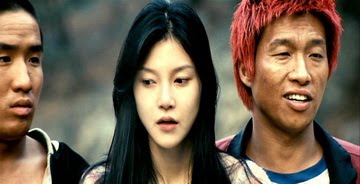
3-IRON


3-IRON
Country : South Korea
Year: 2004
Genre: Drama – Romance – Thriller - Fantasy
Running Time: 88'
Director: Kim Ki-Duk
Cast: Seung-yeon Lee, Hyun-kyoon Lee, Hyuk-ho Kwon, Jin-mo Ju

GHOUL RATING: 
5-
****(*)

STORY: Young Tae-Suk wanders through the apartments of people on vacation: for a while he enjoys their homes, doing small repair jobs and then leaves quietly, without stealing anything. His ghost-like hauntings of these homes are matched when he encounters a battered woman sulking in a lush, apparently uninhabited house. They become attracted to one another, but there are many obstacles for their unconvential affair: an angry husband, police, murder charges, golf balls...
REVIEW: People are limited by their environment but also by their own inner being. And yet they try to reach out into the world, into someone else's existence and make a meaningful contact in their own very peculiar way. In Kim Ki-Duk's films this contact is never verbal; never could the debased words establish a real communion between souls. The method can be violence (BAD GUY); it can be eroticism (SAMARIA); it can be sado-masochism (THE ISLE); it can be even silence (THE BOW) – but never, never words. This director distrusts words more than any other I can think of; and whatever they do, his characters almost never talk to one another. It is not because they have nothing to say. On the contrary, it is precisely that they have too much on their minds, things too important to convey for them to be dragged down in words. In a world in which every soap opera or 'Reality TV' person is ''madly in love'', in which feelings are all too easily labeled, Kim Ki-Duk's protagonists cherish their private world too much to even try to verbalize it. Words like ''love'', ''hate'', ''passion'', ''revenge'', and the like do not even BEGIN to describe the essence standing behind their motivations (often mysterious to themselves as well).
Such is the case with 3-IRON, Kim Ki-Duk's best work so far. It is best because here he manages to capture the elusive essence of complex emotions in such a pure, unadulterated manner that by the end of the film his characters become more ethereal, more mysterious than they were in the beginning. The two outcasts, outsiders in a world governed by money, power and violence, ''live'' their solitary lives of Kafkean detachment verging on non-existence: Sun-Hwa broods, silently rejecting her husband's brutishness (undiminished – or, one could argue, even augmented by his wealth and social status), while Tae-Suk leads a vicarious existence assuming, at least temporarily, other people's lives. Both of them are trying to diminish themselves – to hide from the outside world, to be too small to be noticeable – to become no one, to be nothing. These are the same sentiments that made Gregor Samsa metamorphose into a bug. But in contrast with Kafka's universe, in Kim Ki-Duk's there is also love. Often strange, unspeakable, indescribable, beyond the grasp of external observers – but none the less powerful or life-changing for that.
So, the two outcasts meet, and immediately form a microcosm of two. It is through silences that they speak, it is through looks that they touch, it is through music (the stunning, elegiac Oriental mood piece by Slvain repeated several times in the film) that they make love. Never has Kim Ki-Duk been so adept in using silence, or music, or sparse sounds from the outside world. Never has he been so lucky with actors as in this film: Hyun-kyoon Lee practically carries the film through his body language and his looks, making Tae-Suk an astonishing character – one of the most likable (while, at the same time mysterious) in recent cinema. He's immensely helped by Seung-yeon Lee's portrayal of an abused but undefeated wife who is brought to life through the contact with her own silent partner. Together they are alone against the others, and with the newly-found power of love they dissolve from this world.
3-IRON is pure poetry in film: a visual, aural and atmospheric treat unlike anything you've ever seen, a great existential love affair painted with subtlety (and occasional burst of violence) by one of the greatest masters of world cinema working today. Absolutely recommended for all those who do not mind their entertainment heady, sentimental, ambiguous and a bit slow-paced. If, however, your idea of entertainment is mostly fast-paced action, suspense/gore-filled horror or laugh-riot comedy, be warned that the 'entertainment' score for this film would probably be 3,5 or 4. But I guess that no one comes to a Kim Ki-Duk expecting the usual fun. For the lovers of the unusual, the score is certainly 5.

11/24/2009

BLOODY ARIA (2006)

Country: South Korea

Year: 2006

Genre: Thriller

Running Time: 115'

Director: Won Shin-yun

Cast: Lee Byuong-jun, Cha Ye-ryun, Han Seok-gyu

Oh Dal-Su

GHOUL RATING: 2 (**)

Story: A seemingly minor incident snowballs into an uncontrollable situation. An aspiring opera singer (Cha Ye-ryun) travels the countryside with her mentor (Lee Byuong-jun). After he attempts to rape her, she flees straight into the hands of the leader of a group of thugs who want to play some cruel games with their visitors from the big city. With the car stuck in the sand and no help in sight, the two will have to find a way to escape the clutches of these criminals before someone gets seriously hurt…

Review: A number of excellent films are invoked in reviews attempting to describe BLOODY ARIA. Some of the titles which are invoked include classics like STRAW DOGS, DELIVERANCE, THE HILLS HAVE EYES, or more recent genre fare like WOLF CREEK or ORDEAL (CALVAIRE). A word of advice: don't be fooled by these comparisons. BLOODY ARIA does not manage to approach even the middling affair like ORDEAL and certainly offers very little to merit being mentioned in the same sentence with the rest. While it's not exactly an ordeal to watch, it does not bring anything new or especially worthwhile to the table, and ends up being only moderately entertaining for the lovers of sadistic cinema.

To be sure, the director Won Shin-yun, who debuted with the haunted hairpiece flick (THE WIG), provides predictably high-blown reasons for his violent second film: "I wanted the audience to feel the pain and wanted to wake their subconscious sense of submission. I wanted them to look back at themselves and those around them and see our society for what it is: full of irrationality." Someone should have told him that the irrationality of the society is not a good enough excuse for a screenplay that's too haphazard for its own good. His "fable of violence in the Korean society" (as he describes it) would have been more effective had he bothered to actually deliver a strong set of characters from different strata of society (like STRAW DOGS and DELIVERANCE have done), instead of peopling his movie with a dozen of caricatures. Even a clever set-up and pay-off along the lines of THE HILLS HAVE EYES would be something, but BLOODY ARIA is underwhelming in those departments too.

The beginning shows some promise, but the film very soon becomes stuck just like the car in the river bank's sand, and starts revving without going anywhere for too long. The film's main problem is that it cannot honestly decide what it wants to be: its set-up seems to lead towards an orgy of ultra-violence (and the blurbs and promotion support this), but it boils down to a boring picnic with brawling rednecks in which no one gets killed! There's a threat to a bullied youth in a sack, but he survives. There's a threat of rape, but nothing happens. There's a beautiful and imaginative sadistic threat in the form of four people buried up to their necks in sand and doused with gasoline – but… you guessed it: nothing happens! Oh, yeah: the film is unpredictable. It makes you expect something – and then it doesn't deliver! How clever!

Tables are turned, but unconvincingly. It's laughably unbelievable when a skinny-assed youth starts applying his karate chops to a gang of thugs. Twists are provided to reveal new identities and new relationships between the characters, but this is so forced that it ruins the documentary realistic feel that the director was striving for. The clash between the different social groups is presented in the most obvious and predictable manner: professor vs. student = abuse of power, attempted rape; snobbish urbanites vs. village idiots = mutual distrust and hatred; police vs. citizens = power creates submission, submission leads to violence.

And that brings me back to my main complaint: BLOODY ARIA is comicky when it should've been serious, and tries to be serious when it should've been excessive and exploitative. The attempts at drama are laughable; the action is silly and unsuspenseful; the baddies are not sadistic psychos but mere pathetic bullies; and the horror and brutality are mild, unimaginative and anti-climactic. Won Shin-yun says: "BLOODY ARIA is not just a dry social drama. The movie tells an unpredictable story with a black humor and suspense twist that scares you while you laugh and that makes you laugh as you get scared." Trying to have it both ways, both as a "social drama" and as a suspenseful action horror comedy whatnot, the movie fails on both accounts and ends somewhere in the dull, forgettable middle.

The technical aspects are OK and the film looks fine in its wintry desaturated colors. The cast boasts several well-known faces: actress Cha Ye-ryun was seen in two above-average horrors, THE VOICE (WHISPERING CORRIDORS IV) and MUOI: THE LEGEND OF THE PORTRAIT. Han Seok-gyu was in GREEN FISH and PRESIDENT'S LAST BANG among others, while Oh Dal-Su is recognizable from OLDBOY, LADY VENGEANCE and …CYBORG, CRYING FIST and A BITTERSWEET LIFE. Their acting is decent within the confines of this particular script. All in all, BLOODY ARIA is neither bloody nor operatic enough, but it's not too bad either, so you might want to give it a chance – once you forget the comparisons to far greater movies and settle your expectations to a decent-to-mediocre, but watchable flick.

11/21/2009

ROGER CORMAN INTERVIEW

Academy of Motion Pictures Arts and Sciences (AMPAS) decided to give an honorary Oscar to Roger Corman this year. He received it a few days ago, and this event is as good opportunity as any to post an interview I did with him last year (2008).

Roger Corman was a special guest at last year's Grossmann Festival of Film and Wine in Ljutomer, Slovenia, where he was given the Vicious Cat award for life achievement.

Still vital at 82 and enthusiastic about his films and the fresh DEATH RACE remake (which he co-produced), Corman talked to the festival audience and also devoted some time to answer the questions of his most devoted fans from this part of Europe. Other than DEATH RACE (which, according to him, goes "straight for the throat" eschewing the social commentary and satire), he also announced several creature films, like CYCLOPS for Sci-Fi channel, that he's working on. This interview was originally posted at www.beyondhollywood.com .

My questions had mostly to do with his gothic horror films.

Here is that part of the discussion:

Dejan Ognjanovic: What was it like to work with Vincent Price?

Roger Corman: Vincent Price was a great gentleman and a joy to work with. All I had to do was give him a brief idea of what I wanted with the character, and he understood immediately. It was one of the best collaborations I've ever had.

DO: So, he did not require a lot of directing, right?

RC: No. I do not believe in over-directing actors. I've always believed in discussing the motivation of the character with the actors, what they were looking for, and then a minimum of direction on the set. I trust the actor.

DO: Some reviewers called him a bit of a ham. Was that approach of slight exaggeration and tongue in cheek his own, or did you ask him to play his Poe roles in that vein?

RC: No, I did not want it exaggerated. If there was any exaggeration, and there was a little bit, it came later on. On our very first picture, THE FALL OF THE HOUSE OF USHER, he was very serious. Then, after we have done three or four of them, he started pushing a little bit, but not much. THE RAVEN, of course, we played for laughs. It was a great fun having him together with Boris Karloff, Peter Lorre and Jack Nicholson.

DO: How did they collaborate on that film, having in mind that they are very different in terms of their background, acting style, personalities etc.

RC: There was a little bit of friction, but not a great deal. Peter Lorre was a method actor, Stanislavskian actor who played Bertold Brecht's plays in Berlin and when Hitler came to power, Peter came to the United States. He would improvise, make up lines, and this threw Boris off a little bit. Vincent was OK with it, but Boris was the kind of actor who came, read the script, memorized the lines, and gave the exact performance that was on the page. Peter had a vague idea of what the script was, and he would make up all kinds of things. Vincent could work with both of them. He was classically trained enough to do it exactly as written with Boris, and then he improvised with Peter. But Boris had trouble with Peter, and I believe on the second or third day of shooting he came to me and said that it was difficult for him to work with Peter, and I said to Peter: "You have to stay closer to the script, since Boris is having difficulties following you," and I said to Boris: "You could loosen up a little bit, understand that Peter is going to improvise a little bit," and after that they got along very well.

DO: And wasn't Peter also drinking a little bit in those days?

RC: No, not on the set. If he was in real life, I do not know of it. But that's an interesting point. I've worked with a couple of actors who were known for drinking, and they took their work very seriously: they were not alcoholics. They would get through the day of shooting – one of them, I won't give you his name, he said to me: "I have a martini at 5 o'clock in the afternoon of every day, and I want you to know this before we make this picture. After that I may have a second and third martini. So I suggest you do all the close-ups on me before 5 o'clock. I will still be able to act, I'll be in shape to play the scene with others, but the close-up should not be on me during the evening." And he stayed true to his word: he would remain sober until 5 o'clock, but around 4.30 you could see that he was already looking forward to this (laughter). But in general, those guys took pride in their work, even if they were heavy drinkers, they didn't do it on the set.

DO: What about Ray Milland?

RC: Ray Milland was very much like Vincent in that he was educated, very carefully and classically trained. The slight difference was that Ray Milland was a very handsome man, he used to be a romantic lead, while Vincent was more like a character actor leading man. So, Ray brought a little bit more of a smoothness, whereas Vincent brough more of an edge in the character.

DO: What about the rumor that there was a line at the very end of X – THE MAN WITH X RAY EYES that was cut from the film? Stephen King, for example, claims in DANSE MACABRE that he'd heard there was a line, after Milland's character plucks out his own eyes, where he screams: "I can still see!"

RC: No. I've heard that story, but what we have in the film is the ending we've always planned.

DO: And as for the visual effects, did they come off exactly as you wanted them, considering the budgetary restrains and technical limitations at that time? Did you, perhaps, want him to see something more specific, like some strange places or creatures behind our reality?

RC: I wouldn't have him see creatures. I wanted him to see deeper and deeper and at the end to see through to the center of the universe. I wanted it to be a very mystical film, so I never thought that he would see creatures.

DO: What I meant by this question is that I've always felt that plot was vaguely Lovecraftian, about a man who sees through reality and discovers a darker reality behind, and in Lovecraft's mythology there is this blind idiot god Azathoth at the center of the universe – not exactly a creature, but an amorphous deity...

RC: I wanted to leave that in the open, not stating what it was. I've always believed that every person in the audience sees a different picture. What they see is half of what the filmmaker put on the screen, and half of what's in their own mind. So, what might be there in the end of the film, I leave to the audience.

DO: In other words, if you were to remake it, or at least produce the remake, you wouldn't go with today's technology and special effects and show more than you did in 1963?

RC: As a matter of fact, I've thought of that. Of all the films I've made if I were to remake one, that's the one that could be better now, with modern special effects. It was a small film shot in three weeks for a small amount of money, and we didn't have very much money for special effects. I think the film would be very much improved with the special effects we have today. But still I wouldn't be specific at the end of the film.

DO: But perhaps now you could include a bit more of nudity than what was allowed back then?

RC: (Laughter) Yes, that could be done.


DO: What do you think about today's directors working in the low budget arena? I have a feeling that they're playing too safe just as their mainstream counterparts, although they are not risking huge amounts of money like them.

RC: Yes, I think that the new directors coming up today are technically better than the new directors rising back in my days, and they mostly went to film schools, while I never went to film school, I learned what I know on the set. So, they have more technical knowledge, but sometimes their vision is a little bit limited. They understand special effects, they work very well with computer graphics, but with some of them there is a certain self-limiting quality. Also, with big pictures, you cant't really gamble with hundred million dollar pictures. You're forced to play it safe. And even some independents, with lower budgets, tend to play it safe – I know it myself, I've played it safe, too, a couple of times – but I prefer to gamble, which is of course easier when your budget is a few hundred thousands of dollars.

DO: Did you have any kind of restrictions back in those days when you were shooting a film in a few days? I mean, physically, in terms of exhausting yourself and your crew when you made a whole film in a couple of days and nights of shooting.

RC: Yes, the Screen Actors Guild has a rule that a screen actor has to have a 12 hours off between calls. If they don't get 12 hours off, then you pay them double on the next day. So what I would do is use a reasonable working day, which for me is around 10 or 11 working hours and then go home and sleep and come back the next day. But if I am forced to work 12 or 13 hours I arrange my schedule so that the actors who work first in the morning finish earlier, so that they get their 12 hours between calls.

DO: I know directors hate questions about influence, but still I must ask about the possible inspiration from the Hammer's gothic horrors from the late 50ies and Mario Bava's from early 60ies. Did they influence your Poe films in any way?

RC: Not really. The first of my gothic films was THE HOUSE OF USHER (1960), and when I made it I hadn't seen any Hammer or Mario Bava's film. Later on I did see a couple of Hammer films and Mario Bava's films, and I was not particularly impressed with Hammer films, but was impressed with what Mario Bava was doing. He really was a brilliant director.

DO: Can you please elaborate on that, as I'm a great fan of Bava's work. What was it that appealed to you in his work?

RC: It was more than 40 years ago, I'm trying to remember what I saw back then. I was particularly impressed by his direction of the actors, the way he got complex characterization in a type of horror film where characters are sometimes very simple. Also, I thought he was really wonderful with the camera, I liked his kind of hard dark lighting, and then the light against the dark, the chiaroscuro that he used.

DO: You also worked with his star, Barbara Steele, in THE PIT AND THE PENDULUM. I heard that she was not too happy to be in gothic horror films. What was she like to work with?

RC: I heard that she did not want to be stereotyped as an actress in horror films, but when I worked with her, there was none of that. I got along with her very well. She took her part very seriously and I was pleased with her. She was a very nice person.
DO: I have a question about MASQUE OF THE RED DEATH, which is my favorite film of yours and probably the best script you've ever had, at least among the gothic horrors you made. It has some memorable lines, and I heard that Vincent Price contributed to many of them, that he re-wrote his dialogue etc. Is that true?

RC: Vincent always did that, not a great deal, but a little bit, and I always encourage actors to do that, to modify dialogue a little bit to fit their persona, so that the speech becomes natural to them. It's interesting that you mention the script for that, because scripts for most of my Poe films were done by Richard Matheson, who was a very good writer, and in MASQUE OF THE RED DEATH I went with Charles Beaumont, a good friend of mine. I finished shooting SECRET INVASION in Dubrovnik on Saturday, and on Monday I was in London, doing pre-production for MASQUE OF THE RED DEATH. Bob Campbell, who wrote SECRET INVASION, came along with me and a lot of my crew from Hollywood came with me. I think that the original script as written by Chuck Beaumont needed a little bit of complexity, and I talked one evening with Bob Campbell, and he came up with the idea to include Poe's story HOP-FROG as a subplot. We had two weeks of pre-production in London, and during these two weeks he added more subtext, and I think it worked very well.

DO: What can you say about Nicholas Roeg who shot that film?

RC: Nick Roeg was one of the best camera men I've ever worked with, he gave me a very rich lighting style. Again, my way of working with the camera men is to discuss the look, the style and mood of the film. And again, like I said about Mario Bava, I always liked those deep, rich colors against light colors, and in Englad in those days they didn't use the term "camera men", they called them "lighting directors", and that's what Nicholas Roeg was, and his use of lights I like the most.

DO: Would you say that there is such a thing as "the Roger Corman world-view"? You've made so many different films in so many different genres, and yet the auteur theory claims that a great director is present in each and every one of his films, whether it is an action film, horror, teenage comedy, SF, etc. Is there something that you might say connects them into a whole?

RC: There might be. Sometime I was referred to as "Hollywood's oldest established rebel". I'm a little bit anti-establishment, a little bit in favor of the outsider, the person who is not quite inside, and I'm politically a little bit to the left off center.

DO: So the breakdown of those mansions and castles in your films is not just a gothic cliche but a metaphor for the breakdown of established order?

RC: As a matter of fact, the best ending we've had along those lines was done by a young director Alan Arkush who did for me THE ROCK'N'ROLL HIGH SCHOOL, which was a comedy rock'n'roll picture, and at the end the students blow-up their high school (laughter).

DO: Were you embittered by the experience on FRANKENSTEIN UNBOUND (re-cut by the producers), and was that the cause that you did not want to direct any more?

RC: Not really. I've been around long enough to know that these things happen. Not everything goes smoothly, and that film was not being done for my company, so I didn't have the complete control nor the director's cut.

DO: So how come that you did not direct after that?

RC: I just felt I was getting too old. I'm supposed to get up at 8 o'clock and go to the set to shoot, but instead it's much easier to go there at 10 o'clock (as a producer) and say to the director: "What did you shoot that for? What was in your mind to put your camera there?" (laughter) Of course, I do not really do that, but... you understand.

DO: Do you ever feel the need to direct at least one last picture?

RC: Sometimes I do think about it, but for that I'd need a project that I'm really passionate about, and right now I do not have a script like that.

11/20/2009

THE BEST JAPANESE HORRORS OF ALL TIME (2)


THE BEST JAPANESE HORRORS OF ALL TIME

HAUNTED PAST, PSYCHOTIC PRESENT, DYSTOPIAN FUTURE

PART II

PSYCHOS

The very first glance at the bulk of Japanese horror films reveals at least two notable conclusions. The first is the sheer bulk of horrors about psychos, madmen, human killers. Even if you discard the direct-to-video exploitation splatter sickies, you're left with an incredible number of relevant, high quality horrors dealing with this subject. After all, this is the primary reason for dividing this chapter on the best Japanese horrors of all time into two parts. There's just way too many good Japanese horrors dealing with psychos. The second thing that one notices immediately is that Japanese psychos are quite different from the Western ones. Apparently, there is a widespread psychosis inherent in the contemporary Japanese society that a lot of people can relate to and maybe even recognize their hidden feelings and urges in the acts of violence perpetrated so often on cinema and video screens. And there are many elements within this madness that make it typically Japanese.

Western psychos are often slaves of the past: the roots of their insanity lie in some trauma from the past, and usually closely connected with their parents. 'My sick mother/father made me do it!' Boys brought up as girls, girls brought up as boys, boys confused about sex due to a strict religious education, things like that. The shadow of Norman Bates (PSYCHO) looms large over all those. Of course, in slasher flicks psychos are taken for granted, they are ready-made monsters that require no elaborate explanation or motivation. Madness is an alibi enough in itself, now let's get to the real business, which is – slashing oversexed teenagers. Those papier-mache 'psychos' are mostly inspired by Michael Myers (HALLOWEEN), and often wear masks which further distance them from humanity and recognizable motivation.

Japanese psychos, on the contrary, are not so much slaves of the past as they are of the present. Even when their motivation can, at least in part, be linked to some family ties, their madness seems to be primarily nourished by the society en large. Rather than products of disfunctional families, Japanese psychos are, by and large, products of the contemporary Japanese society where alienation, distance and detachment, lack of affect, indifference towards others and selfishness seem to be rules of the day. The necessity to succeed in an over-competitive community produces a lot of strain. Fear of failure is haunting people on every step of the societal ladder, from the elementary school via university all the way to the eventual job one (hopefully) gets. When there is so much pressure, of course there will be outbursts of outrageous, often violent reactions. That is why violence in Japanese films has such orgasmic qualities, rarely achieved in their Western counterparts. While not always convincing on the most literal, physiological level, the Japanese geysers of blood are more than convincing as portrayals of psychological truths: they are vents in a pressure-cooker of a strongly dehumanized society.

For the sake of clarity this overview of Japanese psychotronic cinema is divided into two parts. Part one deals with horrors in which psychosis is seen 'from inside': madmen are their main characters, and the viewer spends most of the time in the claustrophobic confines of their insane microcosm, sharing their sicko frame of mind. These madmen are governed by obsessions, weird passions and perversions which are predominantly sexual. In many respects they live like 'otakus', a particularly Japanese phenomenon to be elaborated on below. Part two of this overview is devoted to horrors in which, instead of a limited microcosm, psychosis is seen in a wider context, 'from outside'. These films often have a structure of a police procedural (as exemplified by the blueprint provided in SE7EN), or sometimes of a slasher-drama. More about those in the next chapter: for now, let's go back to our obsessive friends.


PSYCHO OBSESSION:

When Japanese are obsessive about something or someone, the results are often more extreme than anywhere else in the world. At least that's what we learnt from their movies. Just look at that classic conclusion of Oshima's IN THE REALM OF THE SENSES (1976) where the strong passions lead a possessive woman to cut off her lover's penis. The strict rules of propriety, decency, hierarchy etc. through the ages have created a rather rigid context which is always a fertile ground for unbridled outbursts of vehement passion. That's why even the classical Japanese literature (should I remind you of Yukio Mishima?) and cinema (A WOMAN IN THE DUNES, IN THE REALM OF THE SENSES,...) abound in outrageous psychosexual acts.

Modern Japan has provided a context for a new kind of psychos embodied in the 'otaku' figure. While most of these are quite harmless, the extremities of their lifestyle sometimes lead to unspeakable violence. Otakus are teens or twens, mostly boys. They despise physical contact and live a mediated 'life' through the media (TV, video, DVD, internet), technical communication and simulation in general. "Identity diffusion syndrom" and an "ego vacuum" have today become the 'normal' state of affairs. Distance and detachment govern their lives. Yamazaki Koichi, a historian of Japanese everyday life and an authority on otaku, sees the origin of this social phenomenon in the changes in Japanese culture in the '70s. Otakus are the children of media and technology. They grew up as only child with daddy always out at work, and mummy very eager that her son studies hard so he can enter a good university so he can enter a good company. The cliche Japanese success story. And the kid goes into hiding behind piles of toys, comics, and play machines. There is a communication breakdown between parents and their children, which transcends the usual generation gaps found elsewhere.

The severe communicational barriers between parents and children led to a series of killings of parents by their sons. It started in 1980 when a boy, who would today probably be called an otaku, had slain his parents with a metal baseball-bat. The 'kinzoku bat murderer', as he was known, was followed up by five or six other youngsters in a very short time. The most famous case was revealed in July 1989 when Miyazaki Tsutomo (27) was arrested for the suspected abduction and murder of four girls age four to seven and the attempted molestation of another girl. His case is paradigmatic for numerous otaku-like psychos that are later found in the movies like ALL NIGHT LONG, EVIL DEAD TRAP 2 etc. In his room in Tokyo were found piles of manga and a collection of 6000 videotapes, including child pornography and horror-videos. He was socially isolated, didn't dare approach women, was working as a printing shop assistant, was crazy about video and comics, and drew comics himself. He took videos of two of his victims so he could view them later on. He claimed that he commited the crimes as if in a dream and without intent. The defense counsel contended that he was emotionally immature and had difficulty making a distinction between himself and others. "He lacks understanding of life and death, and has a strong desire to return to his mother's womb," the defense counsel said. The defense argued that the audiovisual culture of videotapes and television, the lack of a sense of reality in the information society and the isolation of youth are behind the crime as sickness of modern society.

There is an even more extreme sort of otaku called 'hikikomori', a name which refers to those who retreat from society into complete nothingness, holing themselves up in their bedrooms at their parents' homes and doing anything to fill the hours. One of them writes: ''I sleep until my eyes are about to rot. I see dreams.'' The sickness of modern society, indeed. It's embodied, among other things, in the 'rorikon', or 'Lolita complex', named after Vladimir Nabokov's novel. It signifies the strange sexual taste for teenage girls which is so widespread in Japanese popular culture, including movies, that Western viewers are often confounded (or attracted!) by the omnipresent fetishism of schoolgirls' uniforms, white panties etc. as seen in the films like WIZARD OF DARKNESS, FUDOH, and their more extreme direct-to-video brethren.

All of this creates a very peculiar cultural background in which psychos are not isolated incidents or exceptions, but embodiments of a pervasive social malaise. Here are the best Japanese films dealing with the obsessions which, no matter how personal and individual they may seem, always represent a madness much wider... and deeper. If you look long enough into these psychos' worlds, who knows – maybe they’ll start looking back!


ONIBABA, aka THE HOLE, 1964

Dir: Kaneto Shindo


A young woman and her mother-in-law live alone in a huge marsh. It is a time of unrest: a civil war is raging, and in their backwater seclusion they merely try to escape destruction and survive. Their mode of survival is ingenious: they seduce and kill the wandering samurai and live off selling their armor. The story proper begins when their son's/husband's friend returns from the battle with the news of his death. The man goes back to his old shack in the marsh nearby. He introduces the element of unrest in the women's life. The subdued passions start raging just like the winds which constantly blow the reeds around them. The older, but still attractive woman decides to scare off her son's wife in her nocturnal vistis to the neighbor using a demon-mask stollen from a recently killed samurai...

While the lonely women from Japan's middle ages cannot be called 'otaku', their seclusion from the rest of the world and complete devotion to immoral passions, disregarding the consequences, makes them direct ancestors of modern-day urban psychos. As serial killers motivated by survival, they are clearly products of unstable times with shaky moral values. Their psychosis becomes apparent only when the sexual drive is introduced: it is the mirror which finally shows their distorted, demonic faces. Shindo's stunning black-and-white photography portrays them with a mixture of sympathy and detachment, never losing sight of the wider context of their setting. The reeds in constant waves, never still, provide a suitable metaphor for the tumults of their society but also of the waves of passion and wild nature which emerge from beneath layers of 'civilization'. Crucified between Eros and Thanatos, the two women are as powerless as their victims, 'like flies to wanton gods'...


MOJU, aka THE BLIND BEAST, 1969

Dir: Yasuzo Masumura


A blind sculptor kidnaps a model in order to study her beauty in captivity and create a masterpiece inspired by her perfect proportions and texture. He imprisons her in a black room decorated only with enlarged bas-reliefs of female lips, eyes and other body parts. After several unsuccessful attempts to run away, she accepts her destiny, and begins a genuinely disturbing relationship with an already demented artist which leads to an outrageous culmination.

This is the grand-daddy of all later, idiosyncratically Japanese products which manage the impossible – merging of sado-erotic exploitation with the genuine artistic exploration. No one is better than the Japanese when it comes to providing the sensual titillation at the same time with intellectual stimulation! The above synopsis could be mistaken for the plot of some Z-grade schlocker of Jesus Franco or Ted V. Mikels, but in this Oriental instance it is treated with all seriousness and artistry of a legitimate 'festival flick'. Inspired by the story of Japanese Edgar Allan Poe – Edogawa Ranpo – Masumura's film is a masterful examination of voyeurism and fetishism inherent to all cinema. It is a masterpiece in which the very texture of the film, with its claustrophobic and surreal design, becomes the objective correlative of its ideas and obsessions, and strikes you subconsciously, sidestepping reason and logic, and haunting you forever with the imp of the perverse you'd never known you had.


EVIL DEAD TRAP 2: Hideki

Dir: Hashimoto Isou


A fat, asocial projectionist lives her life of quiet desperation with occasional outbursts of hatred towards normal women expressed through violent butchering in which their wombs are extracted. When her sole acquintance (it would be too much calling them 'friends') gets a boyfriend, a very intimate rage starts brewing... Oh, yes, there will be blood!

(P.S. There is no real connection with either first or third part of EVIL DEAD TRAP: their sole connection is in the haphazard title, and thus each can be viewed independently. Part I is discussed in the next chapter, while part III is disappointing, unoriginal and boring, and does not merit inclusion among the all time best.)

Depression, sexual frustration and feelings of low self worth govern the world of EDT2: it is a claustrophobic, gloomy microcosm of meaningless existence, a death in life which turns into a 'death to life' stratagem of survival, as embodied in the killer's focus on victims' wombs and ovaries. Very few films, either Japanese or otherwise, have managed to capture with such chilling beauty and terror the desolation of a character driven beyond the normal existence. As it usually happens in the best examples of this sub-genre, the world of alienation and emotional distance is not limited to the private world of a psycho: it merely coalesces the forces at work in a much wider context. Rarely has the world of 'normalcy' looked as repulsive as here. Rarely has Tokyo looked as devoid of human life as here. Excellent photography, with vivid, Argentoesque colors and a haunting electronic score create an ambiance that is at the same time stylized and frighteningly real. The elliptical narration may alienate some viewers, but reason and logic have died long ago for our protagonist, and the greatest achievement of EDT2 is in capturing her outlook and feelings without too many words. The sights and sounds manage just fine. Through the bulk of this film bloodletting is present, but not excessive; in the final scenes, however, it becomes copious beyond belief. The final two chapters on the DVD are called 'Blood Balet' i 'Prelude to Madness'. Check out why.


ALL NIGHT LONG 2: ATROCITY, 1994

Dir: Katsuya Matsumura


A shy otaku boy becomes a prey of an amoral bisexual lad and his group of thugs. At first he's merely bullied, but later becomes their disciple in the art of humiliation and torture. Otaku resists, but when his cup is filled he turns against his 'teachers' in an orgy of unspeakable bloodshed.

This is the second, and by far the best part out of five (so far) in a highly intriguing and quite intelligent series dealing with the violence in contemporary Japan. More specifically, it coldly depicts the process of contamination with violence, in which victims easily turn into tormentors. It portrays the nihilistic landscape in which brutality seems to be the only accessible 'language' of communication between people reduced to objects. This parable of alienated Japanese youth is filled with brutal sexual violence (where rape is only the beginning) and imaginative, copious torture and splatter. It's bleak beyond belief: no one gets out of here alive or sane. There are no 'normal' bonds: no parents, no lovers, no friends. All characters are reduced to either subjects or objects of desire. Rape or be raped. Kill or be killed. Survival of the fittest at the price of sanity (and humanity). Dehumanized, soulless creatures roam the lifeless scenery of Tokyo where electric and phone wires only stress the distance between people. Loud airplanes provide the soundscape for the apocalyptic devastation in which no exit is in sight. There is no salvation, everyone is doomed from the very beginning, and various acts of violence are just pointless twitches of the death nerve.

While this description goes for more or less all five parts of this series (all directed by Matsumura!), part II is exceptionally good because a) it has more likeable characters; b) it is most convincing in presenting a genuine Sadean philosophy; c) the torture is incredibly vicious even for Japanese standards. Highly recommended only for the strongest stomachs!


MERMAID IN A MANHOLE, 1995

Dir: Hideshi Hino


A painter discovers a real mermaid in the sewer. She's half-dead already. He tries to save her, or at least to preserve her through his art. Her skin decays in scabs and boils filled with blood and pus, while worms and centipedes emerge constantly... Seeing that there's no way of saving her body, he becomes obsessed with an attempt to create the ultimate portrait - painted with her blood and multicolored pus.

Even the most hard-hearted splatter fans will have a hard time stomaching this gruesome flick since it contains some of the most outrageously disgusting images ever committed to screen. However, beyond the oozing body liquids, vomit, crawling vermin and body parts, a careful viewer will notice a dark Cronenbergian poem about human mortality and transcience of all ideals and dreams. Its utlimate nihilism seems to be the suggestion that not even art can transcend the loathsome facts of life regulated by the biological determinism. The flesh is weak... and bloody... and slimy... and there's no escaping it! The only faults in this film can be found in its low-budget origins (spare sets and not always superb make up effects), visulas sometimes cheapened by the video technique, and poor acting by some side-characters. This is by far the most original, inspired and intelligent part of the otherwise boring and puerile GUINEA PIG series.

(P.S. The GUINEA PIG films are worth mentioning only as a peculiar socio-cultural phenomenon, as the epitome of the trend in which sadistic torture of women is sold as 'entertainment', and also as a showcase for quite convincing make up effects. However, they have no other merits and are not worthy to be discussed among 'the best' Japanese horrors.)


GEMINI, 1999

Dir: Shinya Tsukamoto


A long-lost twin returns to his brother, a respected surgeon in early 20. century. He throws the doctor into a well and assumes his role. The doctor is left to ponder his attitude towards his underprivileged patients as well as mysteries connected with his wife's past...

This is Tsukamoto's successful attempt to create a genuine Japanese gothic with such ingredients as: family secrets, doppelgangers, mysteries of identity and unrecognized kinship, stormy nights and unexpected, violent twists... GEMINI is a highly stylized film in which for the first time in Tsukamoto's opus one can find colors like golden-yellow, green, violet, red... Even in this costumed, period piece Tsukamoto continues his obsessive scrutiny of the Japanese identity through the character of a man who discovers unknown possibilities within himself (usually with the 'help' of a femme fatale). Rather restrained, GEMINI uses only sporadic bursts of frenetic camera movements or trade-mark quick shock cuts. The music by Tsukamoto regular Chu Ishikawa is (as always) pure genius.


AUDITION, 1999

Dir: Takashi Miike


A widower organizes an audition for non-existent film in order to meet a perfect wife. He gets far more than he bargained for: a beautiful, but mysterious girl whose idea of possessiveness transcends all boundaries of normality.

Great success at international film festivals brought a revelation to the Western public: an ingenious auteur, a mad genius of unpredictabilty - the one and only Takashi Miike. The film opens like a deliberately paced drama with hints of wry humor and satire on Japanese men's attitude towards women, dating, sex, etc. Then it progresses into the darkly bizarre territory reminiscent of later Cronenberg (a great influence on Japanese filmmakers, both with his early SF-horrors and with his later disturbing psycho-dramas). Towards the end, however, it grabs you by the throat and punches you in the face, guts and groin with unexpected, yet quite meaningful scenes of unpalatable torture and terror, both physical and emotional. The shocking ending will devastate you not only with its perfectly directed visceral imagery but also by its implications. This is a haunting, multilayered, thought-provoking masterpiece of first order and one of the most important films made in any country, any genre, anywhere in the past decade.

11/19/2009

APARTMENT 1303 (2007)


Country : Japan

Year: 2007

Genre: Horror

Running Time: 94'

Director: Ataru Oikawa

Cast: Noriko Nakagoshi, Eriko Hatsune, Yuka Itaya, Naoko Otani, Arata Furuta


GHOUL RATING:

*(*) 2-


Story: Moving into her first apartment, Sayaka invites her friends to come over to celebrate. During the party, she begins to behave strangely, discovering a newfound taste for dog food and the like. Suddenly she runs to the balcony and plunges to her death – from the 13th floor of a modern, very unscary apartment building. At her funeral her friends refuse to believe this was a suicide. Her mother muses: "Why did it have to be HER?" Such comments are not pleasing to her sister, Mariko. So, she starts snooping around, and discovers that any single girl who rented the apartment 1303 ended up jumping from the balcony. As always, there's a wronged, abused victim turned into an evil she-bitch ghost, and the two must clash their fists in the end. Expect a cliffhanger (i.e. balcony-hanger)...

Review: Words fail me to describe this tired retread into J-horror territory which, for some reason, comes under the label 'Asia extreme'. The only thing extreme about this affair is the boredom you'll feel if you're careless enough to buy or rent it. The old saying goes: one shouldn't judge the DVD by its cover, but in this case I think you should. The markedly unoriginal DVD case tries to ape the original RING with a huge, staring eye with red iris whose black pupil is shaped like a keyhole. A flow of long black hair on the side goes without saying.

The distributors are trying sell this second-rate material as something worthwhile, so they claim on the same cover: "From the author of GRUDGE." Kei Oishi wrote the novel on which THE GRUDGE was based, but his writing job on 1303 is nothing to bre proud of. The script goes through the motions of all the predictable ingredients of J-horror you'd expect, never infusing them with any real emotion, idea or inventive scare.

We have familial abuse. More specifically, a mother who abuses her daughter. I wonder, what's the deal with those Japanese: in the whole civilized world it is predominantly fathers who are abusive to their families, but not so in Japanese horrors. According to them, mothers are to be blamed. It is always big bad mammas responsible. By this I do not mean only the neglecting mothers who leave their kids alone for too long, thus causing disaster (as in RINGU, DARK WATER, etc.), but also those from ONE MISSED CALL and every other sad clone of those, including the Korean ones (THE GHOST, BLOODY REUNION, etc.). It's always mothers! The formula remains the same: father is absent (either dead, left the family, or just inexplicably NOT THERE), mother is left alone with her child and... shit happens! Someone should write a thesis on 'Absent fathers and questionable mothers in Japanese horror cinema'. It would probably be boring, but not as much as APARTMENT 1303.

We have suicide. Another leitmotif of J-horror. Just like rape, it's in every other Japanese movie. A lot of angst floating there, I guess, looking for a vent. Not finding one outside, it turns upon itself. OK, in this case, suicides are supernaturally motivated (aren't they all?), but since the origin of everything is in the mother who abused her daughter... some disturbing shit is in between the lines. Sadly, nothing much is done with that. The opening has some attempts at drama and dealing with the loss of a loved one, but it is quickly forgotten: the plot requires our heroine to become a detective, since only by finding the truth about the ghost one can exorcise it. Or something like that. Noriko Nakagoshi is doing a very decent acting job, but seems wasted in this material. The middle section is mind-numbingly predictable (a rare wake-up call provided by a newspaper title which screams: MUMMIFIED MUMMY!) and the end is as silly as they come. It provides a first: the scene in which a character reasons with a ghost and convinces her how and why she should stop her spectral shenanigans! And it seems to work – until the stupid twist ending which throws everything down the drain wherefrom it shouldn't have crawled in the first place.

Do we have scares? Gotta be kidding me. Loud ominous noises. Bombastic score (the opening is reminiscent of Bernard Hermann – but that's all; this ain't no Hitchcock). Spooky calls from cell phones. (Why the hell are Japanese so scared of kitschy pink cell phones? No, don't write an essay on 'Internet, cyberspace, cell phones and other techno-gadgets in modern Japanese horror film'!) Creepy little girls. (There must be an essay on 'Fear of the children in modern Japanese horror film: guilty consciousness and return of the repressed.') Close ups of faces frozen in a scream. (How about 'The influence of Edward Munch's 'The Scream' on Japanese horror film'?) Hairy horrors. (In this case hair becomes more similar to tentacles, which provides a couple of moderately fine images, though much cheaper and less elaborate than those in EXTE.) Dreams within dreams within dreams. ("Phew, it was all a dream. No, wait, this is a dream too!.." etc.) Should I even go on? I don't think there's a cliche they DIDN'T use here.

All in all, APARTMENT 1303 is not only unoriginal, it does not even TRY to be original. A mechanical, routine, unambitious cash-in on the J-horror trend, it will mildly entertain only the most undemanding. Consider yourself warned, and enter this apartment at your own risk. No, nothing scary will happen there. You'll fall asleep before the mid-section's playing detective and digging through the newspapers and books bores you silly.

11/18/2009

DUST DEVIL: IN THE CLAWS OF THE EVIL DEMIURGE

Richard Stanley's DUST DEVIL is burnt into the imagination of a devoted cult of followers as one of the most original and profound portraits of the demonological in the entire history of the flickering images.

His Devil is, and yet is not quite the Devil we're used to. He is, technically, a serial killer, but his methods and his motivation make him one of a kind. DUST DEVIL is, among other things, a horror film – but it is also so much more.

Stanley's Demon is in human guise, although he does not embody the usual moral: ''There's no Devil equal of Man''. Humanoid shape is, in this case, just a mask - a veil over a reality much deeper and older than mankind. The essential nature of the Dust Devil is numinous. Refreshingly divested of burdens of Christian dogma that weigh down so much of contemporary demonic cinema, Stanley's metaphysics is based on the ancient gnostic creed. His is a Devil beyond the usual concepts of Good and Evil. The key idea of the film comes straight from the gnostics, and is pronounced by the Dust Devil himself: ''There is no good or evil, only spirit and matter. Only movement toward the light - and away from it.''

According to the gnostics, our world is a mistake, a failure. Material existence is a product of the Evil Demiurg, a malevolent deity. The real God is overthrown, powerless. It's hard to believe that a good God had anything to do with this world. Christian Church had to bend backwards in order to force upon its believers a questionable merciful deity. The gnostics believe that everything, from far-off stars to the nuclei of our cells carries the mark of the original imperfection inherent to the Creation. In the midst of this material darkness there is a spark of light, concieved by the original God, as a trace of our true being. The goal of a gnostic is to tear through the veil of delusion and burst through the screen of false reality into his original homeland, the otherworldly realm of the True God.

Stanley admitted this much about DUST DEVIL in an interview to Donato Totaro: ''It basically dispenses with conventional morality and tries to replace it with a totally different idea of movement toward the spirit or away from the spirit. The friction between matter and spirit, rather than good or evil is definitely outlining something similar to gnostic thought, although I wasn't that aware of gnosticism when I made the movie.''

According to the mythology of this film, Dust Devil is not the Christian Devil, he is not even the top demon. He belongs to a legion of ancient beings, trapped in human form, roaming the secluded parts of the Earth in desperate attempts to get rid of the material shell. For the ritual to be successful, he must release as many sparks of life (or souls, if you wish) trapped in those who are already half-way out of this world. The desperate, the haunted, the suicidal are his food. Dust Devil is not a serial killer – he is a serial savior!

A black shaman describes him thus: ''He is of the spirit. We were put here just for his use. We're nothing to him. We're dust in the wind. His world is older than ours. He's been here since the first times, he and his kin, walking in our shadows. Leeches, growing fat on the world’s pain. He's smelt Bethany dying, and he's come for souls, to build his Power, to return to the Realm of the Spirit. Until this ritual is completed, he's trapped, like us, in a material world, bound by the flesh. He must work through human form ahile he’s in this world. So he’s vulnerable to human failings. Only through ritual, through gaining power over the flesh, can spirit awake to a fuller consciousness. To work the ritual, he must keep moving, moving.''

And this aspect adds another layer to the complex tale Stanley has concocted: his killer is a haunted, doomed figure too. His actions are predetermined. He is trapped just like his prey. In one brave scene Stanley shows him weak, crying next to a woman. In another, he's staring helplessly into the mirror, unable to cross to the Other side. He's in the claws of the Evil Demiurg as well. Only severing the bonds of spirit to the matter can bring him closer to salvation.

The Devil is, obviously, a figure that Stanley deeply sympathizes with, and he's presented in the film knowingly, with numerous allusions to the multifaceted archetype invoked. Stanley's Devil is a Stranger, an Alien, a Man with No Name. A Shape-shifter: bringer of instability, enemy of fixity. The Great Pretender, Actor, Liar, Fool, the Man with a thousand faces. Dweller of the Crossroads, gateways, bridges, crosses where worlds intertwine; Guardian of the Gate of Passage, the top Initiator. Inhabitant of the Desert, bringer of extremes, Avatar of emptiness and desolation – or transformation. He's the One from the mirror, the other side of reflection: the double, the doppelganger. Defined by the fire, heat, flaming red, shimmering of the hot air above the desert dust or asphalt, the deceiving fatamorgana. The Tempter, the Seducer, the Trader of souls. Carrier of the male energy, defined by the phallus and horns. The Defier. The Rebel. A haunted, roaming soul. A Damned One who feeds on the damned. Ambivalent shadow of 'Evil' through the centuries. Anti-hero, dissatisfied with the assigned role. Ultimately, a puppet whose strings are in the hands of the Evil Demiurg.

Namibian desert, the oldest in the world, becomes the most adequate stage for the primeval, timeless drama. South Africa is at the Edge of the World, both geographically and symbolically. That is the home of the Fish River, trickling through the world's second largest canyon, home of the great Snake Father, Kouteign Kouroo. According to the beliefs of local natives, the great Snake Father created the canyon with the lashings of his gigantic tail back in the ancient time of the red light. Stanley describes this place in his production diaries as ''a land that no longer seems to be part of man's universe, an untenanted, unfinished world, the terrain of Gods and Spirits''. This is the same location that Kubrick used for the opening segment ('Dawn of Man') of 2001: A SPACE ODYSSEY, and in Stanley's vision it is the stage for the 'Twilight of Man' as well.

This is the edge of the abyss.

What lies beyond?

It's either destruction or transformation.

In this place even the Devil is not a metaphor or psychological concept but a very possible, even tangible reality: a roaming spirit at the beginning and end of the world.