Приказивање постова са ознаком books. Прикажи све постове

11/17/2014

HORROR MOVIE HEROES


I'm happy to report that Rue Morgue Library Vol 2: HORROR MOVIE HEROES came out a few months ago and I have finally received my author's copies. This is the follow up to Rue Morgue's hugely successful 200 Alternative Horror Films You Need To See, where I wrote about A SERBIAN FILM.

"Heroes" in this edition are giants of horror film - primarily directors, with some actors and EFX masters added to the mix - that have left their mark on this genre. They are presented through interviews, or at least through words of their prominent and famous colleagues.
HORROR MOVIE HEROES spotlights some of favourite personalities in genre cinema. Includes new and classic interviews with CHRISTOPHER LEE, TOBE HOOPER, ALEJANDRO JODOROWSKY, STUART GORDON, ALEXANDRE AJA, DAVID CRONENBERG, VAMPIRA, RAY HARRYHAUSEN and many, many more.
In this book, my contribution is much more substantial, accounting for nearly 10% of content! Specifically, out of 144 pages, my texts occupy a full 12! Specifically, here you can read my interview with a horror legend like Christopher Lee (2 pages), whom I met at the Grossmann Film & Wine Festival.
In addition to Lee, there is also my interview with STUART GORDON (5 pages), with whom I talked at Fantasia in Montreal in 2010, followed by my mini-essay: 5 REASONS WHY I LOVE STUART GORDON.
There you can also find my interview with Jaume Balaguero (3 pages), interviewed at Grossman two years ago, and  my conversation with the Italian master of make-up and visual effects, SERGIO STIVALETTI (2 pages) whom I caught in Belgrade.  
There's really some good stuff to read here; what I personally enjoyed the most are interviews with Wes Craven, Paul Verhoeven, H.G. Lewis, A. Jodorovsky and Richard Stanley, and it is worthwith a special mention for the words of Peter Bogdanovich about working with Boris Karloff on TARGETS.

The full contents are here:
This book is printed in full color, with a great and inspired design that is one of the trademarks of Rue Morgue magazine. So, this is a book that is nice to have and above all it is a useful read.
You can order your copy if you click HERE.
 

And while I'm at Rue Morgue magazine, here's what I wrote about for them this year. From January to December 2014, these are my contributions to Rue Morgue:

# 141
book review: Rural Gothic

film review: Angst (CLASSIC CUT)

# 142
book review: The Ashgate Encyclopedia of Literary and Cinematic Monsters;
book review: Torture Porn: Popular Horror After Saw

# 144
book review: The Lord Came at Twilight

# 145
book review: Ana Kai Tangata

 
# 146
book review: Searchers After Horror

# 147
article + interview (Laird Barron) "Staying Strange": Year's Best Weird Fiction

book review: The Children of Old Leech: A Tribute to the Carnivorous Cosmos of Laird Barron

# 148
article: Robert Aickman: THE MAN FROM A STRANGER TIME

film review: Michele Soavi's StageFright (CLASSIC CUT)

# 150
book review: The Spectral Link
book review: The Spectral Book of Horror Stories

# 151
book review: A Companion to the Horror Film
book review: A Darke Phantastique


11/13/2013

An Interview with Laird Barron


            If you read modern horror fiction, then you must've come across the name Laird Barron. And remembered it. Not only because it is pretty unique and memorable in itself, but because his writings are, too. Laird Barron is certainly one of the best new horror authors. He has a recognizably vivid, pictorial, no-nonsense style while his themes are commonly connected with the kind of cosmic horror that H. P. Lovecraft made all his own. Now Barron is putting his own distinct stamp on this fertile field – with more testosterone than found in your usual bookish antiquarian HPL-inspired works.  
His latest collection came out a few months ago, titled The Beautiful Thing That Awaits Us All (published by NightShade Books, just as his two previous collections and the excellent novel The Croning). It contains some of his best work ever: my favorites are the novellas "The Men From Porlock", where the mystical horror of the woods leads to an even darker horror of the caves, and "Blackwood's Baby", about hunters becoming hunted by the primal Beast… but all of the others are more than worthy additions to cement his recent reputation as "the scariest writer alive". 
            Here's the interview I did with him for the RUE MORGUE magazine: parts of it were used for the article which appeared in the April issue (a big thanks to its editor, Dave Alexander, for allowing me to publish this online). This is its first appearance in its full, original form.


- How do you feel about the label "Lovecraftian" on your prose? Of course, not implying that it's derivative and imitative, but merely as a tool in description. What's your attitude to the Old Man from Providence and his prose? How did his writing affect you? And how do you feel about some other "pulp" SF-horror writers from that era?


It is, as you say, a tool, critic/reviewer shorthand, and it doesn’t faze me. Although, I am occasionally bemused when something of mine is labeled Lovecraftian and is quite objectively not. I count Lovecraft as a strong influence, but no stronger than that exerted by Peter Straub, TED Klein, or Cormac McCarthy. At the top of his game HPL was a much better stylist than his detractors will admit. Before I found my own voice, and that was an age and a half, I was enamored of his baroqueness. While that luster has faded for me, I remain an admirer of his vision.

Growing up, I read a lot of H. Rider Haggard, Robert E. Howard, Edgar Rice Burroughs, Fritz Leiber, and a slew of other authors who staked out pulp territory back in its glory days. Those are some of the guys who taught me the fundamentals. How to tell a story being lesson one.

- In terms of genre, horror seems to be pretty central to your interests as seen so far. There are spices of SF, action, spy, adventure, noir, western... but the main meat is usually horror. Do you have plans for stories or even novels where the main meat would be something other?
Basically, this question is about another label – how do you feel about the term "horror" (do you prefer "weird" or "strange" or...?) and, regardless of the term, what are your feelings about the genre?

I enjoy horror in its numerous manifestations. Much as I like category horror, it bores me a bit these days.  My preferences increasingly lean toward its use as a spice, rather than as a course. The great strength of the genre is its mutability, its chameleon nature, the way it can be insinuated into other genres. Take McCarthy’s Blood Meridian —there’s a historical western that’s energized and transformed by the infusion of horror and dark mysticism. It’s a landmark horror novel that will never be recognized as such by the main body of readers or critics, and in a perverse way, that’s the ultimate compliment a genre author can be paid.

I’m working on a crime novel and a number of stories that are horrific, if not explicitly of the horror tradition.
 

- It seems to me that some very interesting things are happening in horror literature today, with the overall level of quality higher than in the golden days of mass popularity brought by Stephen King in the early 1980s. Do you agree? Please discuss.
What do you think about horror literature today? Which contemporary colleagues would you single out?

It’s a tough call, comparing the eras. Hard to beat a young King, Barker, or Straub. Michael Shea and Karl Edward Wagner were smashing stories out of the park. TED Klein, too. So were many others. On the other hand, yes, the racks were glutted by dreck and that led to an implosion, not just commercially, but also perceptually. The average reader identifies horror with garbage from the ’80s and ’90s. In some respects the subsidence of mass market horror has done a great service to the genre —the rise of independent and small presses and their willingness to publish literary takes on the subject matter has led to a kind of renaissance. There might be less volume, but the quality is often impeccable.

There are a number of exemplary figures at work, but let me point to a handful of them: Livia Llewellyn, Sarah Langan, Dan Chaon, Stephen Graham Jones, Gemma Files, Kaaron Warren, Paul Tremblay, John Langan, Gary McMahon, Simon Strantzas, Richard Gavin, Ian Rogers, Joe Pulver, Matt Cardin, Norman Partridge, Lucius Shepard, Chesya Burke, and so on. I’m giving some terrific authors short shrift because the list would be too long. Suffice to say, the field is healthy. We’ll look back fondly on this era, I am certain.


- This is your third story collection and you have two novels published. Is this predominance of stories over novels a matter of circumstances or of your general preference to the shorter form (stories, novellas)?

Oh, it’s a little from column A and a little from Column B. I’m addicted to the short form, and have been since childhood. Collections from Dahl, King, and Barker very much sustained my creative soul and influenced my own writing. That said, I’ve written a couple of novels and am in the process of completing more. I imagine my bibliography will be fairly balanced between the forms when all is said and done.


- What's next coming from you? Any novel in preparation? Would it in any way be a continuation of the mythos of your previous novels?

I’ve a number of short stories scheduled to appear in 2013 and 2014, but mainly I’m working on a crime novel at the moment. Very dark stuff. After that, there’s a collection and another novel, both set in Alaska, both horrific and at least peripherally connected to material from my previous works.

5/07/2013

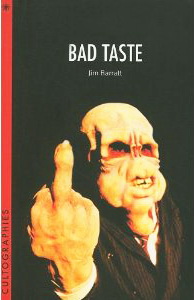
BAD TASTE by Jim Barratt


BOOK REVIEW:
BAD TASTE by Jim Barratt
Wallflower Press
(London, UK – distributed in the US through Columbia University Press)
2008

106pp


The guys of the 'Cultographies' series are back at it again, with some new titles! We've already presented their first three books on this site: THE ROCKY HORROR PICTURE SHOW, DONNIE DARKO and THIS IS SPINAL TAP. You'll remember them as the slightly more accessible variety of what BFI is doing in their 'classics' series: small, serious but readable accounts of the production, evaluation and influence of some major modern titles – in this case, devoted entirely to ''the weird and wonderful world of cult cinema''. The series editors, Ernest Mathijs and Jamie Sexton, now proudly present Jim Barratt's analysis of Peter Jackson's cult classic, BAD TASTE.
            In its form, the book stays close to that envisioned for the whole series: it opens with a personal note (how the author came across the film, what it meant for him back then, what it means for him now), continues with behind-the-scenes facts of the painful birth process (always a fun read when it comes to the usual guerilla filmmaking in the low budget arena!), culminating, of course, with the analysis (what, exactly, makes the particular title the object of a cult following? what does it all mean? what's the significance? etc.) and further relevance for the genre it belongs to and to (cult) cinema in general.
            The author, Jim Barratt, is a fine choice for this book: as a former Film and Video Examiner for the British Board of Film Classification he can provide some rare facts about the various censorship issues that BAD TASTE sometimes encountered, and how, eventually, it was cleared of that danger in most countries, passing uncut in spite of its copious amounts of splattering gore, vomit, goo and the like. Obviously, BAD TASTE was one of those rare instances in which someone actually paid attention to the context of its set-pieces, and the context justified the exception. 
Even the censors were able to recognize that all of the 'bad taste' on display, including exaggerated dismemberments, geysers of blood etc. were used for obvious humorous purpose, in a context that's more infantile than 'nasty'. Barratt also rightly points to the similarities between Jackson's peculiar 'splatstick' (splatter + slapstick) and Monty Python's memorable uses of similarly extreme and intentionally goofy effects, like in the famous gore-galore sketch of "Sam Peckinpah's SALAD DAYS" or in the unforgettable episode from MONTY PYTHON'S THE MEANING OF LIFE with the gluttonous, obese man who gorges himself (and vomits every once in a while) until he explodes all over the fancy restaurant.
            Because of its comedic elements, together with bits and pieces of other genres (Sci-Fi, action, etc.), Barratt claims that BAD TASTE is not really a horror film at all: other than the splatter effects (used for comedic effect), there is no evidence of suspense, fear, creepiness or anything remotely scary (unlike, say, some other splatter-horror comedies, like THE EVIL DEAD or RE-ANIMATOR). Thanks to its light-hearted tone BAD TASTE could expect a better understanding among the frowning censors around the world, and it is certainly one of the keys of its general appeal. Nothing is really dark or edgy about it: it's a series of juvenile 'sick', but essentially inoffensive jokes in which no one (and nothing of value) is really hurt. There is no deeper point, no relevance, no subversiveness to speak of, except the most basic puerile provocation of lavatory humor and childish 'bad taste'.
            It's an exercise in style by a budding filmmaker trying to draw attention to himself by a calculated effort to make a CULT film. There is plenty of evidence in the book that Jackson knew what he was doing, right from the start (see the excerpt from the letter in which he asked for financing from the officials). "BAD TASTE was actively marketed and distributed in ways designed to solicit cult status", says Barratt (page 52). But, significantly, he adds: "But for the film to be adopted as such by its audience, it has to offer them something different, some special qualities worthy of their devotion." Jackson did offer something new and, eventually, rightly got where he is now. 
            The first three films analyzed in the 'Cultographies' series all dealt with some significant issues: gender roles in ROCKY HORROR; time, death and sacrifice in DONNY; rock culture and documentary genre in SPINAL TAP. Unlike them, BAD TASTE is not really about anything, and that may be the reason why this volume is some 20 pages slimmer than the previous entries. Although short, this book is by no means lightweight, and serious tools are used to analyze what little there was to be analyzed. 
It also provides numerous amusing anecdotes and facts about the film (especially the local, New Zealand specific references lost on many international viewers), but one feels much more of the similar material could've been used to make the text somewhat weightier. At least, the book points to numerous sources (articles, books, even web sites) which might be valuable to those cultists willing to explore more background of one of the most inauspicious debuts in the history of cinema. From rags (BAD TASTE) to riches (LORD OF THE RINGS trilogy, Oscars etc.).   
        
The other new 'Cultographies' titles are devoted to Orson Welles's TOUCH OF EVIL and SUPERSTAR: THE KAREN CARPENTER STORY. On the other hand, those interested in BAD TASTE's older (and better) splatstick brother can eagerly anticipate the announced EVIL DEAD volume. Stay tuned!
 
Originally published at Beyondhollywood

4/22/2013

RUE MORGUE: New Horrors!

 You have one more week left to grab the April issue of RUE MORGUE #132 with some great stuff in it – and some of it may be mine.
In this one you can find my review of SLEEP TIGHT, one of the best horror-thrillers of the past year, directed by the Spanish master Jaume Balaguero, whom I had the pleasure to meet at last year's Grossmann film & wine festival. Something tells me you're likely to read my interview with him in some other RUE MORGUE-related thingy pretty soon.
Also, in the CLASSIC CUT, at the very end of the mag, there's my praise of one of the most important books about horror film ever written – and certainly and without doubt THE most important reference book on horror cinema around the world in existence: THE AURUM FILM ENCYCLOPEDIA: HORROR (aka THE OVERLOOK FILM ENCYCLOPEDIA: HORROR in its later, updated edition). If you haven't discovered this gem so far, take a look at my reasons for such a praise before you try to buy this hard-to-find item.
Finally, so far as my contributions to the mag are concerned, there's a feature article devoted to Laird Barron and his latest collection THE BEAUTIFUL THING THAT AWAITS US ALL. He talks about his influences (especially Lovecraft and pulp authors), about horror and noir-western-crime elements in his fiction (that's why the article is titled GODS & GUNS), and there's also my overview of his latest book's highlights.
Sadly, a very rare and unexpected thing happened: the book was due to appear on April 2. Instead, just a few days later, news broke that its publisher, Night Shade Books (who also published his two previous collections + excellent novel THE CRONING) is on the verge of bankruptcy and will most likely be bought by another company – provided their authors agree to the new conditions. The book remains in a limbo while this whole thing with Night Shade Books is satisfactorily resolved, but while you await this truly wonderful and deservedly highly anticipated collection, here's a gift from Barron to all of his devoted readers – a free story on his site, as a sign of appreciation for your patience and support. Check this exclusive horror tale HERE!
So, hurry up, and grab this EVIL DEAD issue of RUE MORGUE (its full contents are HERE) while it's still available.

Only a week from now it will be replaced by the latest – devoted to BRITISH HORROR FILM, new and old. This year commemorates full 40 years since the classic THE WICKER MAN (1973), and to celebrate the May Day, RUE MORGUE offers brand new interviews with the director Robin Hardy and star, Sir Christopher Lee
I'm author of the interview with Christopher Lee since I had the honor to meet and talk to the living legend, also at Grossmann film & wine festival. Read it to see why Lee considers THE WICKER MAN his personal favorite among all the films he's ever been in.  
I believe issue #133 will also feature my review of John Langan's wonderful second collection, THE WIDE, CARNIVOROUS SKY AND OTHER MONSTROUS GEOGRAPHIES, available from Hippocampus Press. Give it a chance – it's great stuff (and has an afterword by Laird Barron)!

By the way, RUE MORGUE has just received Rondo Hatton Classic Horror Award for the Best Modern Magazine and it also got one for Best Magazine Column (It Came From Bowen's Basement by John W. Bowen). 
The very same RM was also shortlisted or second-tied in several other categories:
Best Themed Issue (RM#127)
Best Multimedia Horror Site (The Rue Morgue Podcast),
+ honorable mentions in  
the Best Convention (RM's Festival of Fear)
+ Best Article ("Ghosts of Horror Past: 25 Films That Have Been Lost to the Sands of Time", by Kelly Robinson, RM#124).
            The full list of Rondo Awards can be seen HERE.
            I'm really happy and proud for the opportunity to give my modest contribution to the best existing magazine devoted to horror in cinema and culture!

1/21/2013

GOLDEN GHOUL AWARDS for Achievements in Horror during 2012

           2012 was not apocalyptic, but it was certainly grim: it brought yet another slim, forgettable year in terms of horror cinema. Horror films, especially American, are getting dumber and dumber, and those few which try to be different are fundamentally misguided, limited by their authors' misunderstanding of the genre. 
          Anyway, below you'll find some titles which had at least something going for them. There are also some good books listed (at least in that department we had some truly excellent stuff)!    


GOLDEN GHOUL
for BEST HORROR OF THE YEAR

BERBERIAN SOUND STUDIO

GOLDEN GHOUL
for CREEPIEST HORROR

 LIVIDE

GOLDEN GHOUL
for MOST BRUTAL HORROR

 HIDDEN IN THE WOODS

GOLDEN GHOUL
for BEST ARTY HORROR

 BEYOND THE BLACK RAINBOW
 

GOLDEN GHOUL
for BEST HORROR EXPLOITATION

THE AGGRESSION SCALE

GOLDEN GHOUL
for BEST CREATURE FEATURE

DEAD SUSHI

GOLDEN GHOUL
for BEST FOUND FOOTAGE

 V/H/S

GOLDEN GHOUL
for BEST HORROR COMEDY

 NEW KIDS NITRO

GOLDEN GHOUL
for BEST HORROR DOCUMENTARY

 WEST OF MEMPHIS


GOLDEN GHOUL
for BEST DOCUMENTARY ON HORROR

 HORROR EUROPA WITH MARK GATISS


GOLDEN GHOUL
for LOVECRAFTIAN MERITS
---no one---


GOLDEN GHOUL
for MOST HORRIFIC NON-HORROR

 COMPLIANCE


GOLDEN GHOUL
for SERBIAN CONTRIBUTION TO HORROR

 VIR (THE WHIRL)


GOLDEN GHOUL
for BEST DIRECTOR
Adrián García Bogliano, Ramiro García Bogliano
PENUMBRA


GOLDEN GHOUL
for BEST SCREENPLAY
Alberto Marini
SLEEP TIGHT


GOLDEN GHOUL
for BEST ACTOR
Luis Tosar
SLEEP TIGHT

GOLDEN GHOUL
for BEST ACTRESS
Cristina Brondo
PENUMBRA

GOLDEN GHOUL
For SUPPORTING ACTOR
Michael Fassbender
PROMETHEUS


GOLDEN GHOUL
For SUPPORTING ACTRESS
Iris Almeida
SLEEP TIGHT

GOLDEN GHOUL
for BEST SCORE
BROADCAST
BERBERIAN SOUND STUDIO


GOLDEN GHOUL
for BEST CINEMATOGRAPHY
Laurent Barès
LIVIDE
 

GOLDEN GHOUL
for MAKE UP EFFECTS
Neal Scanlan
PROMETHEUS


GOLDEN GHOUL
For SET DESIGN
Bob Bottieri, Antonio Colin
BEYOND THE BLACK RAINBOW


GOLDEN GHOUL
for MOST PROMISING NEW DIRECTOR 

Panos Cosmatos
BEYOND THE BLACK RAINBOW
 

GOLDEN GHOUL
for SERBIAN HORROR BOOK OF THE YEAR
(Fiction)
Goran Skrobonja (ed)
U ZNAKU VAMPIRA 
(IN THE SIGN OF VAMPIRE)
Paladin


GOLDEN GHOUL
for HORROR BOOK OF THE YEAR

(Unclassified) 

Milenko Bodirogić
O BILJKAMA, ŽIVOTINJAMA I PREDELIMA
(ON PLANTS, ANIMALS AND LANDSCAPES)
Orfelin


GOLDEN GHOUL
for HORROR BOOK OF THE YEAR
(Fiction)

Laird Barron
THE CRONING
Night Shade Books

GOLDEN GHOUL
for HORROR BOOK OF THE YEAR
(Anthology)

Anne & Jeff VanderMeer (eds)
THE WEIRD
TOR

GOLDEN GHOUL
for HORROR BOOK OF THE YEAR
(Non-Fiction: THEORY)
Daniel Olson (ed)
THE EXORCIST: STUDIES IN THE HORROR FILM
Centipede Press 

GOLDEN GHOUL
for HORROR BOOK OF THE YEAR
(Unclassified)
John Landis
MONSTERS IN THE MOVIES
DK: Dorling Kindersley


The beautiful GOLDEN GHOUL ™ statuette was sculpted by Tijana Jevtić based on the design by truly yours, Dejan Ognjanović